Nettie Pollard: Difference between revisions
No edit summary |
|||
| Line 122: | Line 122: | ||
She also joined the [https://en.wikipedia.org/wiki/Campaign_for_Homosexual_Equality Campaign for Homosexual Equality]'s executive committee in 2009, and campaigned for LGBT+ migrants and asylum seekers, including personally organizing finance and defense for several people whose chances of asylum were written off by others. | She also joined the [https://en.wikipedia.org/wiki/Campaign_for_Homosexual_Equality Campaign for Homosexual Equality]'s executive committee in 2009, and campaigned for LGBT+ migrants and asylum seekers, including personally organizing finance and defense for several people whose chances of asylum were written off by others. | ||
Nettie published her most overt perspective on [[MAP]] related issues, in a book chapter titled "The Small Matter of Children." Published in ''Bad Girls and Dirty Pictures: The Challenge to Reclaim Feminism'' (1993), edited by Alison Assiter and Avedon Carol<ref>Avedon Carol being Nettie's friend, the founder of Feminists Against Censorship, and co-author of "Changing Perceptions of the Feminist Debate" with Nettie in the same volume. See also, [https://grokipedia.com/page/avedon_carol Avedon Carol] - Grokpedia.</ref> with contributions from [[Gayle Rubin]] and Tuppy Owens, Nettie argued that "The British [[Feminism|feminist movement]] has never really addressed the issue of children’s liberation."<ref>Nettie Pollard, 'The Small Matter of Children,' in ''Bad Girls and Dirty Pictures: The Challenge to Reclaim Feminism'', ed. by Alison Assiter and Avedon Carol (Boulder, Colorado: Pluto Press, 1993), pp. 105-111. [[https://www.jstor.org/stable/jj.38401871.21 Jstor] link]. [[https://annas-archive.gl/md5/38138de0c0ef229d5cd9075b1661275a Annas Archive PDF] link].</ref> Nettie criticized how the women's movement "would sometimes even cooperate with the most vicious arms of the patriarchal state" | Nettie published her most overt perspective on [[MAP]] related issues, in a book chapter titled "The Small Matter of Children." Published in ''Bad Girls and Dirty Pictures: The Challenge to Reclaim Feminism'' (1993), edited by Alison Assiter and Avedon Carol<ref>Avedon Carol being Nettie's friend, the founder of Feminists Against Censorship, and co-author of "Changing Perceptions of the Feminist Debate" with Nettie in the same volume. See also, [https://grokipedia.com/page/avedon_carol Avedon Carol] - Grokpedia.</ref> with contributions from [[Gayle Rubin]] and Tuppy Owens, Nettie argued that "The British [[Feminism|feminist movement]] has never really addressed the issue of children’s liberation."<ref>Nettie Pollard, 'The Small Matter of Children,' in ''Bad Girls and Dirty Pictures: The Challenge to Reclaim Feminism'', ed. by Alison Assiter and Avedon Carol (Boulder, Colorado: Pluto Press, 1993), pp. 105-111. [[https://www.jstor.org/stable/jj.38401871.21 Jstor] link]. [[https://annas-archive.gl/md5/38138de0c0ef229d5cd9075b1661275a Annas Archive PDF] link].</ref> Nettie criticized how the women's movement "would sometimes even cooperate with the most vicious arms of the patriarchal state." Raising the case of anti-'snuff film' campaigns, she argued that: | ||
<blockquote>''To date, no ‘snuff’ movie, (i.e. where actors are actually killed), has been discovered by police anywhere in the world. No bodies have ever been discovered, and ‘Operation Orchid’ seems to have disappeared, but fear and loathing have been implanted in women's minds.''</blockquote> | <blockquote>''To date, no ‘snuff’ movie, (i.e. where actors are actually killed), has been discovered by police anywhere in the world. No bodies have ever been discovered, and ‘Operation Orchid’ seems to have disappeared, but fear and loathing have been implanted in women's minds.''</blockquote> | ||
Revision as of 00:45, 30 April 2026

Janet (Nettie) Marian Mackenzie Pollard (6th September 1949 - 25th December 2025), known in life as Nettie Pollard, was a pioneering British lesbian activist and civil rights campaigner. She is known primarily for her early involvement with the UK branch of the Gay Liberation Front (GLF, founded in 1970), her work with the National Council for Civil Liberties (NCCL, later Liberty), and her involvement with the group Feminists Against Censorship. Nettie attended and helped to organize the UK's first Gay Pride March, which took place in London on the 1st of July, 1972.[1]
Similar to many early gay and sexual liberation activists who had lived through a time where homosexuality was a "stigma symbol" - as Nettie's friend Ken Plummer (1973) put it - where to "be publicly known as a homosexual [was] to invite your employer to sack you, your parents to reject you, the law to imprison you, the doctor to cure you, the moralist to denounce you, [...] and the queer basher to kill you" (Ibid)[2], Nettie was sympathetic towards other sexual minorities including MAPs and transgender people.
Early Life
Named Janet, but always known as Nettie, she was the daughter of committed Communist parents Jack and Ursula, a civil servant and feminist. Nettie was a vegetarian from infancy, and lost her sense of smell after being hit by a trolleybus. She followed Jack into King Alfred School, a progressive establishment in the London suburb of Golders Green.[3] In an interview with the London School of Economics (LSE), Nettie described feeling "out of place" as an adolescent. She felt she did not "fit in," partly because of her underhung jaw, of which a dentist reportedly told her: "we can break your jaw and push it back; otherwise, how else are you going to get a boy?"[4]
In 1971, when Nettie was 21, she heard about the GLF. Her father Jack read about the GLF in a newspaper, and asked Nettie "this looks exciting, shall we go?" The pair went together to Covent Garden, where Nettie was stunned to discover people talking of revolution and non-monogamy.[5]
Early Sexual Liberation and the GLF

The first meeting of the Gay Liberation Front (GLF) took place on 13 October 1970, in a basement classroom at the London School of Economics. It was instigated by Aubrey Walters and Bob Mellors, who had been influenced by the development of the GLF in the USA following the Stonewall Riots. It was the beginning of a 3 year period of great activity, including demonstrations, debates, street theater, the establishment of a new gay press, and the establishment of communes.[6][7] As described in an obituary for Nettie by Peter Scott-Presland, Nettie "threw herself into the counter-psychiatry group, which campaigned against the idea that homosexuality was a disease. Out of this group came the radical self-help group Icebreakers, of which she was a founder member. Rejecting “objectivity” in counselling, Icebreakers offered instead the positive role model of out and proud homosexuals."[8]
The counter psychiatry group had started in 1970, and included Jeffrey Weeks and Mary McIntosh as members.[9] The group had published the pamphlet Psychiatry and the Homosexual: A brief analysis of oppression (1973), written by 6 gay men, before Nettie joined the group.[10] It was in this group that Andrew Hodges first wrote about Alan Turing - then an unknown figure - which would eventually snowball and culminate in Turing become a revered homosexual icon (despite Turing likely being an MAP / boylover)...[11][12]
In videos including interviews[13] and speeches[14], Nettie often read out GLF activist John Chesterman's 1970 demands (pictured below).[15] The demands, written as a poem, read in part:
- We believe [...]
- That every person has the right
- To develop and extend their
- Character and explore their
- Sexuality through relationships
- With any other human being,
- Without moral, social or political
- Pressure. [...]
- To you, the others, we say
- We are not against you, but
- The prejudice that warps your
- Life, and ours
- It is not love that distorts,
- But hate.
- On your behalf, and ours,
- We demand:
- The same right to public
- Expressions of love and
- Affection as society grants
- To expressions of hate and scorn.
- The right to believe, without
- Harm to others, in public and
- Private, in any way we choose,
- In any manner or style, with
- Any words and gestures, to wear
- Whatever clothes we like or to
- Go naked, to draw or write or
- Read or publish any material or
- Information we wish, at any
- Time and in any place.
- An end to the sexual propaganda
- That disturbs the innocence of
- Children, conditions their image
- Of human relationships and implants
- Guilt and nurtures shame for any
- Sexual feelings outside an
- Artificial polarity.
Nettie was often visibly emotional, nearly brought to tears, when reading them. For Nettie, these demands were "so moving and so profound, and such a long way away from equal rights and gay marriage. [...] It's to do with a completely different type of society, based on love. Really, that's what the Gay Liberation Front was about."[16] In a small book titled "Rainbow Planet," written by the Gay Liberation Front for the 50th Anniversary of the Stonewall Uprising (2019), Chesterman's demands are reproduced at the start with the authors asking "How far do you think we've got? We judge that worldwide John [the author] would be both proud and despairing."[17] For Nettie, the GLF badge was "a liberation badge, not a rights badge."[18]

Nettie wrote for Red Rag, the theoretical journal of the British women's movement.[19] As part of protesting with the GLF, Nettie participated in "kiss-ins" - a variation of sit-ins used to protest the fact that kissing in public was illegal for gays during this time. This activity carried serious risk. In an interview for Attitude Magazine, Nettie's friend Ted Brown stated that "people think we were being flippant [...] but the sentence for that kind of behavior could have been between 5 and 7 years in prison."[20] Nettie also participated in more traditional sit-ins where, for example, a bar or restaurant had refused to serve homosexuals or people in drag...
The London GLF set up the support group "Icebreakers" in the spring of 1973, with Nettie being a founding member. She was 1 of around 30 'icebreakers' who would participate in telephone helplines that people could call anonymously. Nettie described the rationale for Icebreakers as stemming from the fact that "in those days, almost no one was out." Most people were too afraid of being outed to simply walk into an in-person meeting, but might become comfortable enough to do so if they already knew of people there who were sympathetic, understood their concerns, or had similar romantic and sexual feelings to themselves.[21]

Nettie has been quoted as a source on GLF history in many books, including fellow GLF veteran Stuart Feather's Blowing the Lid: Gay Liberation, Sexual Revolution and Radical Queens (2016), No bath but plenty of bubbles by Lisa Power (1996), Queer Footprints (2023) by gay writer Dan Glass, and professional historians' books such as The Way Out: A History of Homosexuality in Modern Britain (Buckle, 2015) and Lucy Robinson's Gay Men and the Left in Post-War Britain (2007).
Notably, the British GLF organization had a London office at 5 Caledonian Road, which the media branch used to publish its writings. This included their official newspaper Come Together, which ran for 16 issues from 1970 to 1973. This same address was used by the longstanding pacifist magazine Peace News, at one time edited by Roger Moody, who was a friend of Nettie's until his death.[22] The GLF also had a Youth group for under 21s - then the male homosexual age of consent - which included members from age 12 and up. The youth group created a "Youth edition" of Come Together, which criticized age of consent laws.
Civil Liberties Activism, the NCCL and PIE
After leaving Icebreakers, Nettie joined the National Council for Civil Liberties (NCCL), initially as a receptionist. She had put her GLF experience on her job application and, as a result, landed the embryonic Gay Rights brief. According to Peter Scott-Presland, she transformed it. The NCCL's Lesbian and Gay Committee published the first detailed reports on discrimination in employment, policing and censorship between 1976 and 1979.
Presland wrote that, "In the wake of partial decriminalization of sex between men, there was much discussion about the anomalies which remained. In April 1976, NCCL adopted proposals for an age of consent of 14, which it submitted to the Criminal Law Revision Commission. When NCCL disavowed this several years later, Nettie became something of a scapegoat and was doorstepped viciously as an alleged paedophile apologist at home by the News of the World while her partner was dying of cancer upstairs."[23]

Prior to the 1970s, "paedophilia" had been an obscure category originating from psychiatry. The historian Nicholas Basannavar has argued that the term only began to enter mass consciousness after intense media coverage around PAL and PIE.[24] In the late 1970s and early 80s, gay groups consolidated to present a more 'respectable' image in the wake of the AIDS crisis and a conservative backlash to the past decade.[25] Before the 1980s, critical thinking around pedophilia and age-gap sex had been more common and socially acceptable to express. In 1976, for example, in a submission to the Criminal Law Revision Committee of the British Parliament, the NCCL argued that "Childhood sexual experiences, willingly engaged in, with an adult result in no identifiable damage... The real need is a change in the attitude which assumes that all cases of paedophilia result in lasting damage". The NCCL argued that the "onus of proof [was] on the prosecution to show that the child was actually harmed," rather than having a blanket ban on child pornography, and advocated the decriminalization of incest.[26]
According to British academic Christopher Moores (2017), "Pollard provided the main link between the NCCL and PIE."[27] "She aligned paedophile rights with a broader politics of sexual liberation," wrote Moores, "picking up on developing arguments that sexual values and ages of consent [...] were culturally and socially constructed, rather than biologically determined." (Ibid., pp. 195-196).
Pollard spoke at PIE's AGM in 1977, offering legal advice about homosexuality and the law as well as supplying members with NCCL fact-sheets on arrests. In the same year, PIE Chairman Tom O'Carroll spoke at a conference on the treatment of sexual offenders in prison, organized by the NCCL Gay Rights Sub-Committee. When W. H. Smith banned the newspaper Gay News in 1976 because the publication featured PIE's advertisements, Pollard argued on behalf of the NCCL that this amounted to censorship determined not by the law, but by ignorance and prejudice.[28]
Whilst most of Nettie's published writing concerns debates about pornography, Moores found an archived letter addressed to the lesbian magazine Sequel and written under the name 'Nettie', in which the author described pedophiles as the "most horrifically oppressed of sexual minorities." 'Nettie' argued that the law should distinguish between tender and violent acts ("which no one in their right mind would condone"), and concluded by stating that "some of the most equal and least exploitative relationships I know of between adults and children have been sexual ones." (Ibid., pp. 200-201).[29]
For Moores, it is "highly likely" that this letter was written by Nettie Pollard, "given the letter's position in folders of material which she compiled." (p. 201). The only other record of Nettie writing about MAP issues under her own name, comes from a 1993 book chapter called "The Small Matter of Children," which displays similar language and ideas.[30]
Nettie commented that NCCL's part in "the battle for gay rights is a long and often boring one." (Ibid, p. 194).[31] Unlike the Women's Rights Sub-Committee, the Gay Rights Sub Committee was more independent and sometimes detached from the rest of the organization.[32] Whilst Nettie's job description covered ‘receptionist duties’, she also ran the organization's switchboard, generated most of the Sub-Committee's paperwork, and was well-versed in legal issues relating to homosexuality (Ibid).[33]
Since the age of consent for male sexual intercourse was 21 at the time but 16 for heterosexuals, it was widely argued that the age should be reduced to 16 for both sexes.[34] This legal disparity, in addition to homosexuality still being highly stigmatized as "sinful," "unnatural," or a symptom of disease / mental illness, meant that teiliophilic homosexuals were more likely to criticize age of consent laws and support other non-normative sexual attractions and practices. Historians such as Rachel Hope Cleves have explained this phenomenon with reference to Gayle Rubin's theory of the "Charmed Circle," where the boundaries of accepted sexual expression were once "so narrow that those who were cast outside its limits shared common ground."[35] "Identity categories that are distant from each other today — like loose women, lesbians, and pederasts — were more proximate when they were all outside the charmed circle."[36] Because teiliophilic homosexuality was so taboo during Nettie's era, gay rights campaigners had what Moores (2017) calls "shared interests" in criticizing the age of consent and defending the civil liberties of other sexual minorities; i.e. "Pollard became sympathetic to PIE's endeavors." (p. 196)...

At some point, Nettie joined PIE. She was member number 70. In May 1975, PIE announced that it affiliated to the NCCL, which had joined following an invitation from Nettie. Both the first Chairperson of PIE - Keith Hose - and his successor Tom O'Carroll - were at times members of the NCCL's sub-committee for gay rights. For his influential book Paedophilia: The Radical Case (1980), O'Carroll gave his "heartfelt thanks" to Nettie, Ken Plummer, and Donald West, "each of whom read the whole text in draft and made many valuable suggestions."
Nettie was also active in the Campaign Against Public Morals, a group created to defend and support PIE members who faced legal battles for "conspiracy" and speech offences in 1981, highlighting what she saw as "the absurdity of conspiracy laws".[37] "Intensely loyal on a personal level," wrote Presland, Nettie "supported individuals trapped by these catch-all offences through times of imprisonment and beyond."[38]
The British art curator and gay activist Barry Prothero - Nettie's colleague and fellow NCCL Gay Rights Officer - attended some of the PIE trial proceedings. He wrote to gay rights campaigners in Canada such as Gerald Hannon of the Body Politic, and in correspondence named British diplomat Sir Peter Hayman as the reason for a 'cover-up' by the British authorities. "It is clear that most of the evidence that was not used was dropped because Hayman [...] was the central figure in its production," he wrote, adding that "although assisting in a “cover-up” may be distasteful, not only the defendants but the entire gay movement in this country would be delighted if this one [i.e. cover-up] succeeded in order to keep the case out of court."[39]
During this period, two lawyers associated with the NCCL, Sir Peter Thornton[40] and Adrian Fulford (later Lord Justice Fulford), the latter a member of the NCCL's Gay Rights Sub-Committee, defended members of PIE in court in the late 1970s and early 1980s - though not under NCCL auspices. According to Moores,
The NCCL was also concerned about issues of employment and privacy for individuals who had not committed any crimes. The ‘exposure’ of paedophiles in the media was, to its Gay Rights Sub Committee, very worrying. In particular, it expressed concern about the way in which a group of men, who had not been convicted or charged for offences, were described in the Sunday People exposure of PAL as the ‘Vilest Men in Britain’. The Gay Rights Sub-Committee supported Tom O'Carroll when he was sacked from his post as Press Officer at the Open University (over which he was also defended by the National Union of Journalists and the Association of University Teachers, who feared that the case might set precedents for dismissing those with ‘Marxist views’)". [...] Pollard and those on her sub-committee closely monitored attempts to prosecute PIE leaders [... and were] especially anxious about the charge of ‘conspiracy to corrupt public morals’. PIE members were charged on conspiracy, obscenity and postal offences; it is worth remembering that at the time no offences against children were raised and no evidence was produced that demonstrated that an adult met a child through PIE. (p. 198).
The NCCL had some more general concerns," Moores explains, "about the use of conspiracy charges during the 1970s, citing their misuse during industrial disputes, the trials of members of the Angry Brigade in 1972 and ways in which they were used as non-specific ‘catch-all’ mechanisms for policing" (Ibid). In later years, the NCCL's relationship to PIE were the subject of intense media scrutiny, implicating senior public figures such as Harriet Harman.

PIE, CHE, and Youth Rights
Nettie Pollard played a leading role in the Campaign for Homosexual Equality, who voted to support PIE at their 1975 conference, and defended PIE's "right to speak and organize freely" at their 1983 conference. Earlier in 1974, the C.H.E. made statements of solidarity with PIE at its annual conference, and included adverts for the group in its Bulletin.
In May 1974, CHE's Working Party on Law Reform proposed lowering the age of consent to sixteen, or twelve in some legal cases. At the time 200-300 youth, mostly young men between 16-20 years old, were being prosecuted for consensual homosexual acts every year. After internal review, in 1973, the idea of twelve for age of consent was dropped. In 1977, CHE passed a resolution at its conference, "supported by the vast majority of delegates", which condemned press harassment of the Paedophile Information Exchange.[41]
CHE "urged caution in responding to PIE, noting ‘as victims of prejudice ourselves’ it was important to think about how wrong information and misconceptions ‘might prevent understanding’." (Moores, 2017, p. 207). As late as 1984, when PIE was in the process of winding up, the CHE continued to recognize that pedophiles still had rights and that it would not ‘disown’ the organization. (Ibid).
In 2010/2011, CHE's annual report shows they had two PIE members on their Executive Commitee – Barry Cutler & Nettie Pollard. The links between gay rights groups, PIE, and gay activists such as Nettie, have been explored in historian Lucy Robinson's book Gay Men and the Left in Post-War Britain: How the Personal Got Political (Manchester University Press, 2007).[42]
Feminists Against Censorship and Later Years
In the 1990s, Nettie began to focus on defending the civil liberties of sex workers, porn viewers / producers, and arguing against pornography's criminalization more broadly. She summarized four then-recent books on pornography for the Libertarian Alliance in "The modern pornography debates" (1994),[43] co-authored with Avedon Carol "Only Words; Making Violence Sexy: Feminist Views on Pornography" (1994),[44] and authored a chapter in Tales from the Clit: A Female Experience of Pornography (1996) - advertized as "True stories from some of the world's most pro-sex feminists."[45]
In 1994, Nettie received an award for being a "Campaigner for Sexual Freedom," from the Erotic Oscars (later renamed the Sexual Freedom Awards) - an annual event started by her friend Tuppy Owens.[46] After being made redundant from the NCCL in 1997, Nettie joined Feminists Against Censorship. She was prominent in the 1990s Spanner defense campaign, where gay S/M practitioners had been prosecuted for consensual sex. She also joined the Campaign for Homosexual Equality's executive committee in 2009, and campaigned for LGBT+ migrants and asylum seekers, including personally organizing finance and defense for several people whose chances of asylum were written off by others.
Nettie published her most overt perspective on MAP related issues, in a book chapter titled "The Small Matter of Children." Published in Bad Girls and Dirty Pictures: The Challenge to Reclaim Feminism (1993), edited by Alison Assiter and Avedon Carol[47] with contributions from Gayle Rubin and Tuppy Owens, Nettie argued that "The British feminist movement has never really addressed the issue of children’s liberation."[48] Nettie criticized how the women's movement "would sometimes even cooperate with the most vicious arms of the patriarchal state." Raising the case of anti-'snuff film' campaigns, she argued that:
To date, no ‘snuff’ movie, (i.e. where actors are actually killed), has been discovered by police anywhere in the world. No bodies have ever been discovered, and ‘Operation Orchid’ seems to have disappeared, but fear and loathing have been implanted in women's minds.
Nettie argued that research has shown that "Far from being ‘innocent’ and becoming sexual at puberty, as was once the common belief, it is now indisputable that everyone is sexual, even before birth. Erection in males is detected in the womb from 29 weeks [...] The vagina is responsive sexually from birth in cyclic lubrication." (p. 108). She explains why past campaign groups (even those led by school students) have lacked involvement by younger children, and provides a lengthy description of secondary victimization in cases of mutually willing but unlawful age-gap sex. For Nettie,
The current moral panic about child abuse has pushed back our recognition of children as sexual actors rather than as merely victims. Denial of children’s sexuality, and the fear that they may be sexually attacked, in fact makes them far more vulnerable to abusive situations. If children are informed about their bodies and how they function, and about what sexuality is, this awareness, in itself, means that children can be much less easily led into unwelcome situations by ignorance of what is really going on. If children know that their bodies and sexuality are their own and should be under their own control, and that sex is not forbidden or dirty, then they are much more confident when it comes to getting what they really want and refusing what they don’t want. In the event of a genuine assault or abusive situation, children who are not taught that sex is shameful can much more easily come forward, report the situation and get something done about it. (p. 109)
She concludes:
Creating an atmosphere in which sex is understood to be so acceptable in a non-violent, non-coercive, mutual environment does not teach children to accept brutal assaults; ignorance supported by scare tactics does not arm children against exploitative adults. Yet, in this over-protective and paternalistic time, scare tactics have become our sole means of ‘protecting’ children. We accept attacks on gays or on the porn industry because we have been conned into believing that somehow suppressing sexual adventure and deviance will automatically — illogically — provide some safety for children. It won't.
Yet merely eliminating harmful age of consent laws will not be sufficient to make children safe and free. To achieve this, children need social and economic power, as well as respect, in every sphere of life, for their needs and desires. Children must be taught as early as possible that their opinions matter, that their experience is valid, and that their bodies are their own possessions, that they can defend themselves against psychological, economic and physical abuses. Just as women couldn’t be autonomous while they were virtually owned by their husbands – we couldn’t own our own money, and it was entirely legal for husbands to beat and rape us – so children are left dependent and victimized by the present situation. Until children have economic power and the right to make their own decisions about choices ranging from schools, clothes and food to friendships and sexuality, children, like women, will not have sexual autonomy.
Confined at home first by long Covid, and then by undiagnosed colorectal cancer, Nettie maintained a huge friendship network and an abiding concern with a variety of progressive causes. In the words of her friend, "She became a Queer National Treasure."[49]
Nettie Pollard died on Christmas Day, 2025, aged 76.
Gallery
-
 Nettie and her friend, fellow GLF veteran activist Ted Brown.
 -
 Nettie interviewed by Attitude Magazine in 2022, alongside Peter Tatchell and Ted Brown.
 -
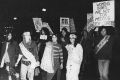 The 1971 GLF Miss World protest, with Peter Tatchell (on far right) and Nettie Pollard (second from right).
 -
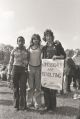 Nettie's friends. L-R: Ted Brown, his partner Noel Glynn, and famous gay activist Peter Tatchell. Young Gay Liberation Front activists photographed in 1972.
 -
 Nettie at the 50th anniversary of the GLF, London UK.
 -
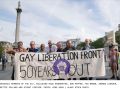 Nettie at the 50th anniversary of the GLF, London UK. Members names listed.
 -
 Nettie Pollard pictured / featured on the far-left, in "Are you Proud?" film poster. Her friend Ted Brown is pictured, as is Peter Tatchell (in a purple suit on the right).
 -
 Nettie at the 50th anniversary of the GLF, London UK.
 -
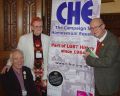 Nettie pictured next to GLF activist Noel Glynn, with her friend Peter Scott-Presland to the right of the picture. The banner / poster next to them refers to the British activist group "CHE" - the Campaign for Homosexual Equality - for which Presland has written the organization's official history.
 -
 Nettie speaking at the 50th anniversary of the GLF, London UK.
 -
 50th anniversary of the GLF, London UK. Peter Tatchell is in the center.
 -
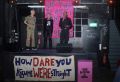 Ted Brown speaking at an indoor event / after party hosted for the 50th anniversary of the GLF, London UK. Nettie Pollard stands in the background.
 -
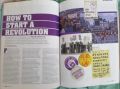 A published historical profile of the GLF.
 -
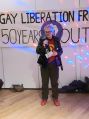 Nettie speaking at an indoor event / after party hosted for the 50th anniversary of the GLF, London UK.
 -
 Nettie surrounded by Leftist books.
 -
 Nettie in her final days...


External Links
- Nettie Pollard and Michael Parkes on Icebreakers and GLF (Video interview published on Youtube by LSE Library, Jul 19, 2024)
- Interview with Nettie Pollard (audio only, transcript available) conducted in 2023 as part of LSE University's GLF Collections - an open-access online repository of documents and oral interviews with GLF activists.
- Nettie Pollard, original Gay Liberation Front activist, reading John Chesterman's 1970 demands (Posted to Youtube by Dan Glass, April 3rd, 2020) - Video description reads: "Nettie Pollard, Gay Liberation Front (GLF) activist, reading John Chesterman's original GLF demands from 1970 at the 'Absolute Freedom for all Party – Gay Liberation Front 50th Birthday Party' - March 2020 at London School of Economics (LSE) - where it all began!"
- John Chesterman's Gay Liberation Front demands, written in 1970 - Nettie loved to quote them!
- Remembering Nettie Pollard: pioneering lesbian activist and civil rights campaigner (Attitude Magazine, 2 March 2026) - Obituary by Peter Scott-Presland.
References
- ↑ Alastair James, World's first-ever Pride march in 1972 remembered by Gay Liberation Front veterans (Attitude Magazine, 24 July 2022); cf. Peter Scott-Presland's obituary for Nettie (cited below), which describes Nettie as a "planner" of the march.
- ↑ See Ken Plummer, "Awareness of Homosexuality" (1973).
- ↑ Information freely adapted from an obituary by Peter Scott-Presland, Remembering Nettie Pollard: pioneering lesbian activist and civil rights campaigner (Attitude, 2 March 2026).
- ↑ Nettie Pollard [Semi-structured interview with Nettie Pollard of the British Gay Liberation Front conducted as part of research on the GLF badge.] (London School of Economics / LSE, Gay Liberation Front Oral Histories project, 06/06/2023). Library source code: HCA/GLF/19/07.
- ↑ Ibid.
- ↑ An account of the GLF entitled No bath but plenty of bubbles: an oral history of the Gay Liberation Front, 1970-1973 was written by Lisa Power.
- ↑ See also, Aubrey Walter, Come Together: The Years of Gay Liberation 1970–73 (1980).
- ↑ Op. cit.
- ↑ Nettie and McIntosh have been photographed together. See Photograph (colour printout) showing McIntosh and others on stage at Gay Pride, 1995 for 25th Anniversary of Gay Liberation Front, annotated on reverse [LSE Library Archives].
- ↑ The document can be read on Scribd.
- ↑ See Alan Turing Documentary Excerpts (Freespeechtube).
- ↑ See Andrew Hodges, Alan Turing: The Enigma (1983).
- ↑ Nettie Pollard and Michael Parkes on Icebreakers and GLF (Video interview published on Youtube by LSE Library, Jul 19, 2024).
- ↑ Nettie Pollard, original Gay Liberation Front activist, reading John Chesterman's 1970 demands (Posted to Youtube by Dan Glass, April 3rd, 2020).
- ↑ Written in 1970 by the late John Chesterman. In September 1971, he organized the Gay Liberation Front’s disruptions of the anti-queer Festival of Light held in Trafalgar Square, Methodist Central Hall, & Hyde Park.
- ↑ LSE video interview w/ Nettie and Michael Parks. Op. Cit. Speech quoted from 4:30 minutes in.
- ↑ Rainbow Planet was written by queer journalist and gay liberation activist Andrew Lumsden, to mark the 50th anniversary of the Stonewall Uprising of 1969. This text was given away during the London gay pride march on June 2019. It is available as a PDF online.
- ↑ Philippa Fletcher and Noah Petts, The Lives and Legacies of the British Gay Liberation Front Badge, 1970–2024, The Historical Journal, 69, pp. 198–220 (p. 207); <doi:10.1017/S0018246X25000093>
- ↑ See Red Rag (Wikipedia). For scans, see the online archive.
- ↑ Source: The former Gay Liberation Front activist who's spent 50 years fighting for LGBTQ rights (Youtube, Attitude Magazine, Jun 24, 2021).
- ↑ Nettie and and Michael Parkes on Icebreakers and GLF - Youtube. Op. cit.
- ↑ Of important historical note, Roger Moody was a British socialist and anti-war activist who has been described as the first person to openly declare himself a "paedophile" in print.
- ↑ Presland obituary. Op. cit.
- ↑ See Basannavar, Nicholas Ranjan Gadsby. (2019). Speaking about speaking about child sexual abuse in Britain, 1965-1991. [Thesis]
- ↑ See Steven Angelides, The Fear of Child Sexuality (2019); See also, the work of Gert Hekma and Philip Jenkins.
- ↑ Mason, Rowena. "Harriet Harman rejects allegations of 1970s link to paedophile campaign". The Guardian, Feb 2014.
- ↑ Christopher Moores, Civil liberties and Human Rights in Twentieth-Century Britain (Cambridge University Press, 2017), p. 195. [Annas Archive PDF link].
- ↑ Ibid. pp. 196-197. The passages here are freely adapted from information in Moores (2017), with attribution.
- ↑ Citation: ‘Nettie’, ‘Paedophilia’ in Sequel Magazine, undated article, U DCL 687/7.
- ↑ For example, both 'Nettie's' argued that society refuses to take children's desires and ideas seriously...
- ↑ According to Moores (p. 194): "The Sub-Committees tasks included lobbying for copies of Gay News to be delivered to prisons, encouraging provincial newspapers to publish adverts for gay switchboards and offering legal advice on prosecutions of gay men. It advised those seeking to ‘come out’, and individuals experiencing everyday challenges of publicly identifying and being identified as homosexual. Advice aside, most attention was given to issues around homosexuality and employment; monitoring individual cases and employment tribunals of those who felt they had been dismissed because of their sexual preferences. [...] If the association with PIE was problematic, it is crucial to mention that the volume and tone of the majority of correspondence on gay rights that came into the NCCL’s office, many of which are moving accounts of those who felt they did not belong, are reminders about the profound and varied inequalities in place for homosexuals in contemporary Britain."
- ↑ Ibid., p. 195. Quote: "The post of a gay rights officer was created following a targeted grant offered by a single wealthy individual to support the post. Those donating to the Sub-Committee often specified that money should be spent on gay rights work and not on the rest of the NCCL’s programme; it recruited its own volunteers, granting it a degree of autonomy.250 Nettie Pollard’s salary as gay rights organizer was covered by specific grants to be directed towards gay rights work. In fact, the Sub Committee was considered an ‘unofficial body’, further reducing the oversight of the NCCL Executive and leadership."
- ↑ As Moores put it, "She connected her own politics and career choice with a wide and long-standing interest in civil rights. Seeing the world from such a perspective meant that Pollard was able to find continuities between less controversial issues typical of the NCCL's work, such as [...] supporting those discriminated against at work, and helping transsexuals forced into guilty pleas for soliciting, with the type of legal challenge raised by PAL and PIE." p. 195.
- ↑ Moores, p. 196: "With the age of consent for male homosexuality in England and Wales so markedly out of sync with that for heterosexual intercourse, the GLF was particularly interested in the subject which was typically used to demonstrate the continuing patterns of inequality and discrimination in the sexual sphere. As conservative moral crusaders focussed on paedophilia in their efforts to preserve the unequal age of consent, certain groups saw the issue as the ‘next front’ in a longer-term battle against prejudice and in support of sexual liberation."
- ↑ Rachel Hope Cleves, Unspeakable: A Life Beyond Sexual Morality (Chicago: University of Chicago Press, 2020), p. 13.
- ↑ "Pederasty," Cleves wrote, "was less taboo before the 1950s, in effect, because so many other behaviors were disreputable as well. Pederasty was less distinct from other types of sexual non-conformity." (Ibid).
- ↑ Presland. Op. cit.
- ↑ Op. cit.
- ↑ See Moores (2017), Op. Cit. Pages 199-200.
- ↑ See his KCL University profile which describes his extensive work and writings on civil liberties issues, noting that "As Chair of the National Council for Liberties and the Civil Liberties Trust, he lobbied Parliament over the ‘sus’ law, identification evidence, confessions and the right to public protest." For discussion, see Guardian article.
- ↑ Source: Wikipedia.
- ↑ Robinson, L. (2007). Gay men and the Left in post-war Britain: How the personal got political (Manchester University Press).
- ↑ Nettie Pollard, "The modern pornography debates", in Libertarian Alliance Pamphlet No. 22 (1994). [PDF Online]
- ↑ Avedon Carol and Nettie Pollard, (1994). "Only Words; Making Violence Sexy: Feminist Views on Pornography", in Media Law & Practice, Vol. 15, No. 3.
- ↑ Cherie Matrix; Feminists Against Censorship (Organization), Tales From The Clit: A Female Experience Of Pornography Female Experience Of Pornography (AK Press, 1996). [Annas Archive PDF link]
- ↑ See Tuppy Owens - Grokpedia. Note that Tuppy Owens had a chapter in conversation with Tom O'Carroll, Chairperson of PIE, in The Betrayal of Youth: Radical Perspectives on Childhood Sexuality, Intergenerational Sex, and the Social Oppression of Children and Young People (London: CL Publications, 1986). Tuppy Owens also has a chapter in Tales from the Clit: A Female Experience of Pornography (1996), cited above.
- ↑ Avedon Carol being Nettie's friend, the founder of Feminists Against Censorship, and co-author of "Changing Perceptions of the Feminist Debate" with Nettie in the same volume. See also, Avedon Carol - Grokpedia.
- ↑ Nettie Pollard, 'The Small Matter of Children,' in Bad Girls and Dirty Pictures: The Challenge to Reclaim Feminism, ed. by Alison Assiter and Avedon Carol (Boulder, Colorado: Pluto Press, 1993), pp. 105-111. [Jstor link]. [Annas Archive PDF link].
- ↑ Presland. Op. cit.